---Advertisement---

Best Camping Pillows in 2026: Lightweight, Comfortable and Packable Options for Back, Side and Stomach Camper

June 28, 2026 6:23 PM
Best Camping Pillows in 2026: Lightweight, Comfortable and Packable Options for Back, Side and Stomach Camper

A camping pillow is easy to dismiss when you are packing at home. It can look like unnecessary weight beside essential gear such as a sleeping bag, shelter and water filter.

Table of Contents

That opinion often changes at 2 a.m.

A rolled-up jacket may collapse during the night. A stuff sack can create uncomfortable pressure around the ear. Clothes may also be damp, dusty or needed for warmth. A purpose-built camping pillow gives your neck a predictable level of support while keeping your sleep clothing available for its intended job.

The challenge is finding the correct balance.

This guide separates those needs instead of declaring one pillow perfect for everyone. It compares current inflatable, foam, hybrid, down-topped and stuffable designs while explaining where each option succeeds—and where it does not.

Product specifications were checked against current manufacturer information and recent comparative field reports. Manufacturer claims are identified as such, and independent testing is used where available.

Best Camping Pillows of 2026 at a Glance

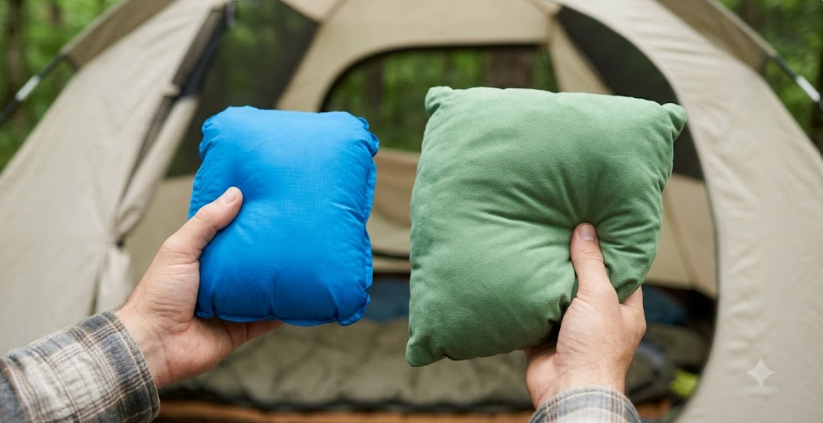
Two campers using different pillow styles in a backcountry sleep setup. Image source: Treeline Review.

The latest Aeros Premium is the strongest all-round recommendation because it combines a genuinely compact packed size with adjustable support, a contoured shape and a thin memory-foam contact layer. Sea to Summit currently lists the regular model at 3.7 ounces, with dimensions of roughly 13 by 9 by 4 inches.

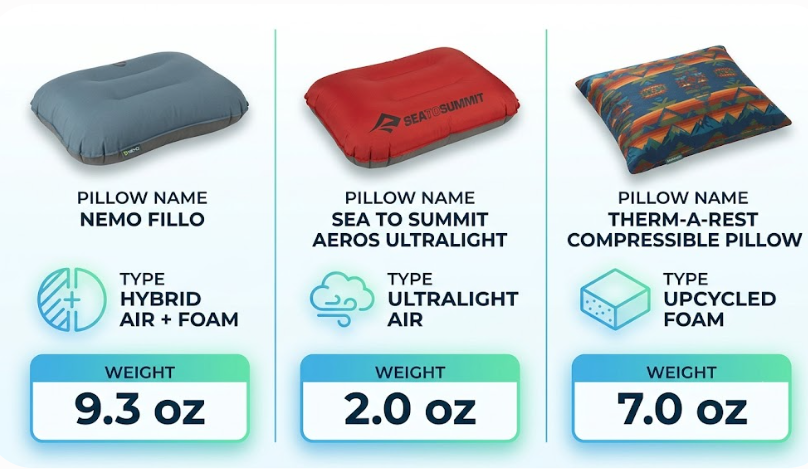
The NEMO Fillo is softer and more home-like, but its additional foam makes it considerably heavier. Recent comparative testing measured it at approximately 9.2 ounces and selected it as the most comfortable backpacking model tested.

Quick decision guide

How We Evaluated the Best Camping Pillows

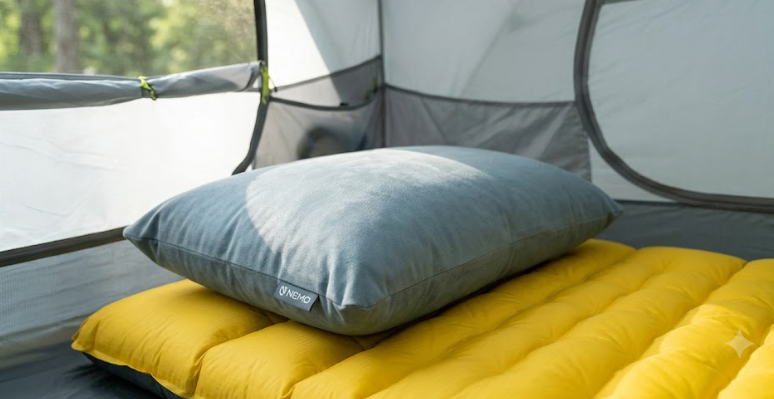
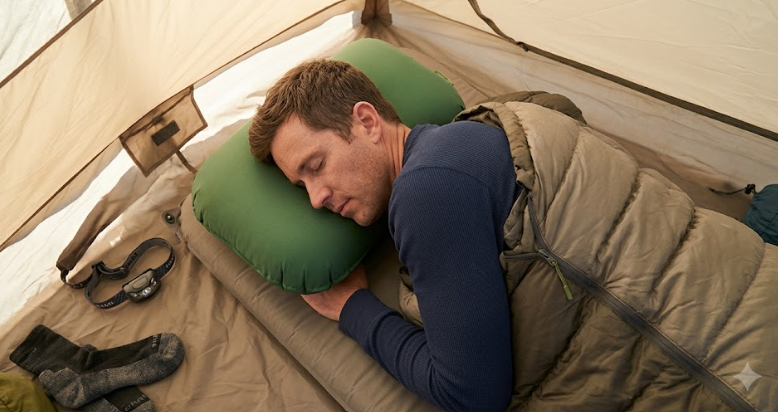
Foam and inflatable camping pillows compared inside a tent

A comparison of compact inflatable and larger compressible pillow designs. Image source: Treeline Review.

A useful camping-pillow comparison cannot rely on product weight alone. A very light pillow provides little value when it repeatedly slides off the sleeping pad or creates uncomfortable pressure beneath the ear.

The following criteria received the most attention.

Comfort

Comfort includes more than surface softness. We considered:

  • Pressure distribution beneath the head
  • Ear comfort for side sleepers
  • Surface temperature
  • Fabric texture
  • Noise when changing position
  • Whether the air chamber feels rounded or unstable

Foam usually provides the most familiar sleeping experience. Inflatable pillows achieve better packability but may feel firm unless they include insulation, foam or a padded cover.

Support and adjustable loft

A pillow must fill the space between the sleeping surface and the head without pushing the neck excessively upward.

Adjustable air chambers perform well here. A sleeper can release a small amount of air until the height feels natural. Compressible foam pillows offer less precise adjustment, although cinch cords and removable filling can help.

Stability

A pillow that moves during the night can be more frustrating than a slightly heavier one that stays centered. Curved shapes, non-slip fabric, pad straps, attachment loops and sleeping-bag-hood compatibility all improve stability.

Packed size and weight

We considered weight in relation to the intended user.

A 260-gram pillow may be excessive for a thru-hiker but entirely reasonable for a camper walking 50 meters from a vehicle. Conversely, an extremely small pillow may disappoint a car camper who had no reason to accept a narrow sleeping surface.

Ease of use

A good valve should be manageable in a dark tent. It should support:

  • Fast inflation
  • Small firmness adjustments
  • Rapid deflation
  • Low-profile placement away from the face

Cleaning and durability

Removable covers are particularly valuable on longer trips. Sweat, sunscreen, dust, hair products and insect repellent can quickly accumulate on the sleeping surface.

Research transparency

This guide does not pretend that every pillow was personally used by the author. Current technical information comes from manufacturers, while long-term comfort observations are informed by independent testers who disclosed their testing locations and methods. One 2026 comparison, for example, evaluated pillows on sections of the Pacific Crest Trail, Colorado Trail, desert trips, international travel and car-camping outings.

The 10 Best Camping Pillows in 2026

Sea to Summit Aeros Premium camping pillow on an inflatable sleeping pad

The updated Sea to Summit Aeros Premium combines an adjustable air chamber with a padded contact surface. Image source: Sea to Summit.

1. Sea to Summit Aeros Premium — Best Camping Pillow Overall

BUY AMAZON

The Aeros Premium offers one of the most convincing combinations of weight, packed size and real sleeping comfort.

Its current design places a 5-millimeter memory-foam layer beneath an engineered stretch-knit contact surface. The pillow remains primarily inflatable, but the padding reduces the hard, synthetic sensation associated with basic air bladders. Sea to Summit also uses a concave center and scalloped lower edge to create room around the shoulders.

The regular version weighs approximately 3.7 ounces, or 104 grams. It provides up to around 12 centimeters of thickness, although most sleepers will find it more comfortable when slightly underinflated.

The included PillowLock patches can be attached to many sleeping pads to reduce nighttime movement.

What we like

  • Strong comfort-to-weight ratio
  • Memory-foam layer improves surface feel
  • Useful height for side sleepers
  • Precise pressure adjustment
  • Compact packed dimensions
  • Pad-attachment system
  • Fits many sleeping-bag hoods

What could be better

  • Still feels firmer than a full foam pillow
  • The standard size may be narrow for restless sleepers
  • More expensive than simple unpadded inflatables
  • The air chamber remains vulnerable to puncture

Best for: Backpackers who want meaningful comfort without carrying a bulky foam pillow.

2. NEMO Fillo — Most Comfortable Backpacking Pillow

BUY AMAZON

The standard NEMO Fillo is a hybrid pillow built around three layers: a baffled air cell, a thick foam component and a washable jersey cover.

That construction makes it feel less like outdoor equipment and more like a compact version of a household pillow. The air chamber controls height, while the foam softens the surface and spreads pressure more evenly.

NEMO says its three-dimensional baffled structure is intended to create a natural pillow shape rather than the rounded profile of a basic inflatable. The cover is removable and machine washable, and the pillow stores in an integrated pocket.

Recent independent testing listed dimensions of approximately 17 by 11 by 4 inches and a weight near 9.2 ounces. That tester considered it the most comfortable option in the comparison, although not the lightest.

Pros

  • Excellent surface cushioning
  • Adjustable height
  • Quiet jersey fabric
  • Washable cover
  • Integrated storage pocket
  • Doubles as lumbar support during travel

Cons

  • More than twice the weight of many backpacking pillows
  • Larger packed volume
  • Slower to pack than a basic inflatable
  • Not ideal for strict ultralight kits

Best for: Weekend backpackers, motorcycle campers and travelers who prioritize sleep quality over minimum weight.

3. NEMO Fillo Elite — Best Lightweight Hybrid Pillow

BUY AMAZON

The Fillo Elite keeps the adjustable air chamber but replaces the standard Fillo’s substantial foam with lightweight synthetic insulation.

The result weighs approximately 85 grams, according to NEMO’s current product information. It combines a three-inch I-beam air cell with recycled Zerofiber insulation and a soft jersey cover.

This is an important middle ground.

A pure air pillow may weigh less, but it usually feels colder and more rigid. A foam-heavy hybrid feels softer but occupies more pack space. The Fillo Elite provides some insulation and fabric comfort without moving into the standard Fillo’s weight class.

Pros

  • Approximately one-third the weight of the standard Fillo
  • Soft removable cover
  • Compact integrated storage
  • Better contact feel than bare TPU
  • Suitable for air travel and backpacking

Cons

  • Less cushioned than the standard Fillo
  • Standard version may feel narrow
  • Some side sleepers may need additional height
  • Costs more than many simple inflatables

Best for: Lightweight hikers who dislike sleeping directly on an unpadded air chamber.

4. Therm-a-Rest Air Head Lite — Best Minimalist Inflatable

BUY AMAZON

The Air Head Lite is designed for hikers who want a genuine pillow but remain highly sensitive to packed weight.

Therm-a-Rest describes it as a pocket-size inflatable with four inches of adjustable air padding. Its stretch-knit face is intended to feel softer than coated bladder material, while the shaped lower edge fits within many sleeping-bag hoods.

The non-slip surface is also useful on smooth sleeping pads, although pad angle and inflation pressure still affect movement.

Pros

  • Approximately two ounces, depending on size
  • Extremely small packed form
  • Four inches of adjustable loft
  • Soft stretch-knit sleeping surface
  • Available in more than one size
  • Useful sleeping-bag-hood shape

Cons

  • Minimal cushioning over the air
  • Can feel firm beneath the ear
  • Less insulating than down or foam
  • Narrower than car-camping pillows

Best for: Fastpackers, bikepackers and ultralight backpackers who want a conventional inflatable pillow.

5. Therm-a-Rest Compressible Pillow Cinch — Best Foam Pillow for the Money

BUY AMAZON

The Compressible Pillow Cinch uses foam left over from sleeping-pad manufacturing, combined with polyester insulation and a soft recycled-fabric shell.

It does not contain an inflatable chamber. That eliminates valve problems and puncture risk while creating a quieter, more familiar sleeping surface.

A cinch cord lets the sleeper change the pillow’s shape and firmness. Therm-a-Rest currently offers small, regular and large sizes weighing approximately 8, 11.5 and 16 ounces respectively. The regular version measures about 18 by 13 inches when expanded.

Pros

  • Soft, household-pillow feel
  • No inflation required
  • No air bladder to puncture
  • Adjustable cinch system
  • Machine washable
  • Three useful sizes
  • Strong value for vehicle-supported camping

Cons

  • Considerably bulkier than an inflatable
  • Takes time to regain loft after storage
  • Too heavy for many long-distance hikers
  • Foam pieces may feel less uniform than solid memory foam

Best for: Car camping, festivals, cabins, flights and short walks from a vehicle.

6. EXPED Down Pillow — Best Down-Topped Camping Pillow

BUY AMAZON

EXPED combines an adjustable air core with a topper containing 700-fill-power, Responsible Down Standard-certified down.

The medium model measures approximately 38 by 28 by 13 centimeters and weighs 140 grams. The larger size measures 48 by 29 by 15 centimeters and weighs 175 grams.

Down improves warmth and softness without requiring the volume of a completely foam-filled pillow. The inner air cushion can also be removed so the outer case can be washed.

Side loops allow attachment to a sleeping pad, which is particularly useful because taller pillows tend to move more when used on sloped ground.

Pros

  • Warm, soft contact surface
  • Adjustable loft
  • Lighter than most foam pillows
  • Two useful sizes
  • Washable outer case
  • Pad-attachment loops
  • Certified down

Cons

  • More moisture-sensitive than synthetic insulation
  • Higher price
  • Requires careful drying after humid trips
  • Down may compress beneath the heaviest pressure points

Best for: Cold sleepers, shoulder-season backpackers and campers who want a softer surface without carrying a foam pillow.

7. EXPED Mega Pillow — Best Camping Pillow for Side Sleepers

BUY AMAZON

The Mega Pillow is designed around a much larger sleeping surface than typical backpacking inflatables.

It measures approximately 52 by 32 by 12 centimeters and weighs 260 grams. Its nearly vertical side walls help preserve usable space around the edges, while synthetic insulation and brushed recycled fabric soften the contact surface.

The large dimensions are valuable for restless sleepers. A narrow pillow may provide adequate support while the head is centered but become useless as soon as the sleeper rolls several inches.

The Mega Pillow can be attached to a sleeping mat through side eyelets, and its removable air cushion allows the cover to be washed.

Pros

  • Large sleeping surface
  • Good height for broad-shouldered side sleepers
  • Soft insulated cover
  • Adjustable air pressure
  • Removable, washable cover
  • Pairs well with wide rectangular mattresses

Cons

  • Heavy for regular backpacking
  • Packed size is much larger than ultralight pillows
  • May not fit comfortably inside a mummy-bag hood
  • Overkill for stomach sleepers

Best for: Side sleepers, active sleepers, van campers and users of wide camping mattresses.

8. Sea to Summit Aeros Ultralight — Best Ultralight Air Pillow

BUY AMAMZON

The Aeros Ultralight removes most of the padding found in the Premium model to reduce weight.

Recent comparative testing measured it at approximately 1.9 ounces and listed an inflated size near 14.2 by 10.2 by 4.7 inches. It was selected as the best ultralight model in that test group.

Its main advantage is efficiency. It gives the user a shaped, adjustable pillow at a weight that is unlikely to affect most backpacking loadouts.

Its weakness is equally clear: the sleeper feels more of the air chamber.

Pros

  • Very low weight
  • Tiny packed size
  • Useful inflated height
  • Shaped rather than completely rectangular
  • Better head support than an empty stuff sack

Cons

  • Limited padding
  • Firmer contact feel
  • Can become unstable when fully inflated
  • Less comfortable for pressure-sensitive side sleepers

Best for: Long-distance backpackers who want to minimize weight without completely eliminating a pillow.

9. Rumpl Stuffable Pillowcase — Best Multifunction Design

BUY AMAZON

A stuffable pillowcase contains no permanent air bladder or foam core. Instead, the user fills it with spare clothing.

This creates several advantages. There is no puncture risk, and the item continues serving as a storage case when it is not being used as a pillow. One recent comparison listed the Rumpl version at approximately four ounces.

Comfort depends entirely on the filling. Soft fleece, a down jacket or sleep clothing can create a good surface. Rain gear, belts, zippers and tightly rolled shirts usually do not.

Pros

  • Cannot develop an air leak
  • Doubles as gear storage
  • Adjustable through the amount of clothing added
  • Soft face fabric
  • Useful for air travel and road trips

Cons

  • Requires spare clothing
  • Can become lumpy
  • Clothing may be needed for warmth
  • Damp or dirty trail garments are unpleasant near the face
  • Less consistent than a purpose-built pillow

Best for: Travelers and backpackers who already carry soft unused layers at night.

10. Zpacks Pillow Dry Bag — Best Multi-Use Thru-Hiking Option

The Zpacks approach combines waterproof gear storage with a fleece-lined sleeping surface.

During the day, the bag protects clothing or sleep gear. At night, it is turned or arranged so the soft side faces the sleeper. Independent testing identified it as a strong option for thru-hikers who value equipment that serves more than one purpose.

It will not reproduce the stable neck cradle of an inflatable or the pressure distribution of foam. Its value comes from avoiding a dedicated single-purpose item.

Pros

  • Functions as a dry bag and pillow
  • No inflatable chamber
  • Appropriate for minimalist systems
  • Fleece side is softer than a standard stuff sack
  • Volume can be adjusted with clothing

Cons

  • Support varies with the contents
  • Less stable than a shaped inflatable
  • Hard objects must be removed before sleeping
  • Clothing can shift during the night

Best for: Thru-hikers who prioritize multifunction gear over home-like comfort.

Inflatable vs. Foam vs. Hybrid Camping Pillows

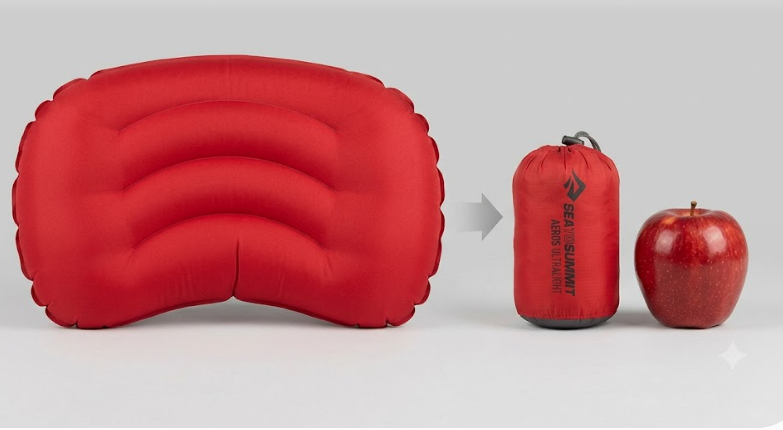
Air-core camping pillow shown beside its compact storage sack

An air-core pillow combines compact storage with a fabric sleeping surface. Image source: Cocoon.

Pillow typeTypical advantageMain compromiseBest user
Basic inflatableLowest weight and packed sizeFirm surface and puncture riskUltralight backpacker
Padded inflatableBetter skin comfortSlightly heavier and costlierGeneral backpacker
Hybrid air-and-foamAdjustable with good cushioningMore weight and bulkComfort-focused hiker
Compressible foamQuiet and home-likeBulkyCar camper
Down-topped airWarm and softMoisture sensitivityCold-weather camper
Stuffable caseMulti-use and durableInconsistent supportMinimalist traveler

Inflatable camping pillows

Inflatables provide the highest amount of loft for the lowest packed volume.

They are easy to adjust, but maximum inflation rarely produces maximum comfort. Too much air rounds the sleeping surface and increases pressure beneath the head. It also reduces the area touching the sleeping pad, making the pillow easier to roll or slide.

A good starting point is approximately 75 to 85 percent inflation.

Foam camping pillows

Foam produces a quieter and more familiar sleeping surface. It spreads pressure over a larger area and continues working after contact with sharp objects.

Its weakness is volume. Foam can be compressed, but it cannot disappear in the same way as an empty air chamber.

Hybrid camping pillows

Hybrid models attempt to combine air-chamber adjustability with a softer top layer.

The NEMO Fillo uses a relatively thick foam component. The Fillo Elite substitutes lightweight insulation, while the Aeros Premium uses a thin memory-foam layer. These variations explain why two products described as “hybrid” can feel very different.

Down-topped pillows

Down provides warmth and softness with a favorable weight-to-comfort ratio. It is less practical in persistent humidity and needs to be dried carefully.

Stuffable pillowcases

Stuffable designs are most effective when the user already carries soft clothing that remains unused during sleep. They are much less convincing when every insulating layer must be worn.

How to Choose the Right Camping Pillow

Camper side sleeping on a foam camping pillow inside a tent

Sleeping position should influence pillow height, width and firmness. Image source: Therm-a-Rest.

Start with your sleeping position

Side sleepers

Side sleepers usually need the most loft because the pillow must fill the distance between the head and sleeping surface created by the shoulder.

Look for:

  • Four to five inches of usable height
  • A broad surface
  • Edge support
  • Fine pressure adjustment
  • Padding above the air chamber

The Aeros Premium and EXPED Mega Pillow are strong examples.

Back sleepers

Back sleepers normally need moderate height. An excessively tall pillow can move the chin toward the chest.

A wider, slightly lower pillow may feel more natural than a narrow model inflated to its full height.

Stomach sleepers

Stomach sleepers generally need the least loft. A tall pillow may rotate the neck sharply.

Choose a soft compressible model or an inflatable that remains comfortable at low pressure.

Consider the thickness of your sleeping pad

A camping pillow does not operate independently.

A firm, thick sleeping pad may keep the shoulder high, increasing the loft needed by a side sleeper. A softer pad may allow the shoulder to sink and reduce the required height.

Test the pillow on the pad you actually use.

Set a practical weight allowance

A useful framework is:

Carry weightGeneral category
Under 2 oz / 57 gExtreme ultralight
2–4 oz / 57–113 gLightweight backpacking
4–8 oz / 113–227 gComfort backpacking
8–16 oz / 227–454 gCar camping or short carries
Over 1 lb / 454 gVehicle-supported luxury

These are guidelines, not rules. A heavier pillow that consistently improves sleep can offer more practical value than a lighter model that stays unused.

Check the width

Campers often compare height and weight while ignoring width.

A narrow pillow is easier to pack, but an active sleeper may roll beyond its edge. Compare the pillow with your pad:

  • A 15-inch pillow feels narrow on a 25-inch pad.
  • A 20-inch pillow gives a restless sleeper more usable space.
  • A very wide pillow may not fit within a mummy-shaped sleeping-bag hood.

Examine the contact fabric

Smooth TPU and coated nylon save weight but may feel slippery or clammy.

Brushed polyester, jersey knit, fleece and quilted covers generally provide a warmer, quieter surface. A removable cover also improves hygiene.

Look at the valve location

The valve should not sit against the shoulder or face. Low-profile valves are less likely to be noticed during sleep.

Consider repairability

A basic air-chamber puncture may be patched. A failed welded seam or damaged valve can be more difficult to repair reliably in the field.

Campers traveling far from replacement options may prefer foam or stuffable designs.

Best Camping Pillow for Each Sleeping Style and Trip Type

Down-topped camping pillow positioned inside a sleeping-bag hood

Compact pillows can be placed inside a sleeping-bag hood to improve stability. Image source: Treeline Review.

User or trip typeRecommended pillowMain reason
General backpackerSea to Summit Aeros PremiumBest overall balance
Comfort-focused backpackerNEMO FilloThick cushioning
Ultralight hikerAeros UltralightVery low weight
Lightweight back sleeperNEMO Fillo EliteSoft, lower-profile hybrid
Side sleeperEXPED Mega PillowHeight and width
Cold-weather camperEXPED Down PillowInsulated contact surface
Car camperCompressible Pillow CinchFoam comfort
Restless sleeperEXPED Mega PillowLarge sleeping area
Thru-hikerZpacks Pillow Dry BagMulti-use construction
Frequent flyerNEMO Fillo EliteCompact and washable
Hammock camperAir Head LiteAdjustable at low inflation
Van or rooftop-tent userCompressible Pillow CinchNo need to minimize volume

Best for hammock camping

Hammock fabric already raises and supports portions of the upper body. Many hammock users need less pillow height than they would on a flat pad.

A lightly inflated Air Head Lite or Fillo Elite is usually more suitable than a tall side-sleeper pillow.

Best for bicycle and motorcycle camping

Packed shape matters alongside weight. Narrow storage sacks fit panniers and handlebar bags more easily than large foam bundles.

The Aeros Premium, Fillo Elite and Air Head Lite are particularly practical.

Best for couples

Two individual pillows are usually better than one double-width pillow.

Each sleeper can choose a separate firmness, height and position. A shared pillow also transfers movement when one person turns.

Best for hot climates

Look for:

  • Minimal insulation
  • Breathable surface fabric
  • Easy-to-wash covers
  • Lower foam content

A basic or lightly padded inflatable may feel cooler than memory foam or down.

How to Stop a Camping Pillow from Sliding

Inflatable camping pillow sitting on a textured sleeping pad

Textured fabric and pad-attachment systems help prevent nighttime movement. Image source: Sea to Summit.

Pillow movement usually results from three factors:

  1. Smooth pillow fabric
  2. Smooth sleeping-pad fabric
  3. A campsite that is not completely level

The following fixes are practical and inexpensive.

Reduce the air pressure

An overinflated pillow has a rounded base and small contact area. Releasing air flattens the base and improves friction.

Use the sleeping-bag hood

Placing the pillow inside a roomy sleeping-bag hood can prevent it from escaping toward the tent wall.

Test this at home. Some pillows are too wide, and some mummy hoods become uncomfortable when filled with a tall pillow.

Use the manufacturer’s attachment system

Sea to Summit supplies PillowLock patches with compatible models. EXPED adds side eyelets to several pillows, while other brands use elastic straps.

Add a fabric layer

Wrapping the pillow in a cotton shirt, fleece or neck gaiter can increase friction while absorbing sweat.

Avoid clothing with:

  • Large zippers
  • Drawcord locks
  • Buttons
  • Wet fabric
  • Dirt or sunscreen residue

Level the campsite

Even a mild downward slope can move both the pillow and sleeper. Position the head slightly uphill where possible.

Add grip dots carefully

Small dots of cured seam-grip material can increase traction. Confirm that the adhesive is compatible with the pillow fabric and allow it to cure completely before use.

Do not attach aggressive tape directly to an expensive sleeping pad.

Camping Pillow Care, Cleaning and Storage

EXPED pillow with the removable air bladder and valve exposed

Pillows with removable air chambers allow the outer cover to be cleaned separately. Image source: EXPED.

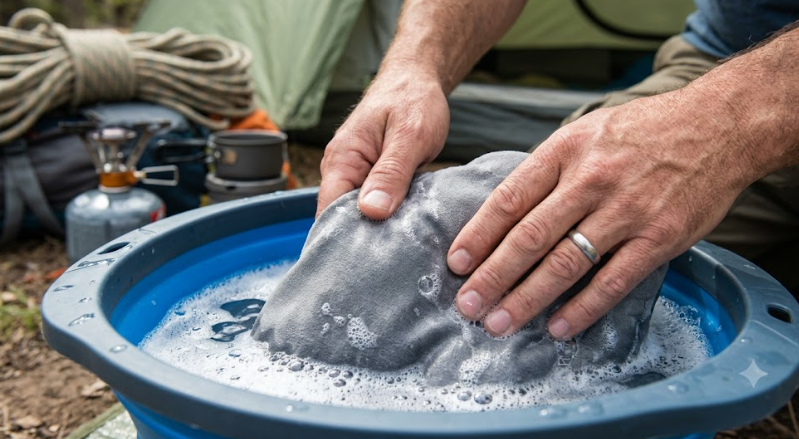
Cleaning an inflatable pillow

Close the valve before cleaning the exterior.

Use:

  • Lukewarm water
  • Mild soap
  • A soft cloth or sponge
  • Shade drying

Avoid harsh solvents, bleach and direct heat. High temperatures can damage fabric laminates and welded seams.

Washing a removable cover

Remove the internal bladder or foam component when the product instructions allow it. Follow the manufacturer’s care label rather than assuming every cover is machine washable.

NEMO identifies the Fillo cover as removable and washable. Therm-a-Rest lists the Compressible Pillow Cinch as machine washable, while EXPED allows the inner air cushion to be removed from its Down and Mega pillow covers.

Drying down-topped pillows

Down must be fully dried before storage.

Break apart clumps gently and allow sufficient airflow. Do not pack a damp down pillow into an airtight storage bag.

Storing foam

Do not leave a compressible foam pillow tightly packed for months. Long-term compression may slow its recovery.

Store it loose or partially expanded in a dry space.

Protecting the air chamber

Clear thorns, sharp stones and metal objects from the sleeping area. Keep the pillow away from pets’ claws and do not use it as a seat unless the manufacturer approves that use.

Carrying a repair patch

A small TPU-compatible patch can save a trip when a pinhole leak appears. Clean and dry the damaged area before applying it.

Common Camping Pillow Buying Mistakes

Side view of a highly inflated hybrid camping pillow

Maximum inflation creates maximum height, but not necessarily maximum comfort. Image source: NEMO Equipment.

Choosing entirely by weight

Weight matters, but it is only one part of sleep quality.

An ultralight pillow that causes neck discomfort or repeatedly slides away is not efficient gear. It becomes dead weight when the camper returns to using a jacket.

Inflating the pillow completely

Full inflation often creates a hard, rounded surface.

Begin below maximum pressure and add air only when necessary.

Ignoring packed volume

Two pillows can have similar weights but radically different packed sizes. Foam occupies far more backpack space than an uninflated bladder.

Buying for the wrong activity

A 450-gram foam pillow may be excellent beside a vehicle and unreasonable on a multi-day mountain route.

Similarly, a 54-gram inflatable may be unnecessarily austere in a large camper van.

Believing every ergonomic contour will fit

A deep head cradle can stabilize one sleeper while forcing another person’s neck into an uncomfortable position.

Test contoured pillows in your normal sleeping posture.

Forgetting the sleeping-pad width

A wide pillow can extend beyond a narrow mummy pad. A narrow pillow may feel lost on a double mattress.

Ignoring noise

Some coated fabrics create noticeable rustling whenever the head moves. Light sleepers should prioritize jersey, fleece, knit or brushed covers.

Overlooking cleaning requirements

A pillow sits against the face for hours. A removable or washable cover becomes increasingly valuable on hot, dusty or extended trips.

How Much Should You Spend on a Camping Pillow?

Compressible camping pillow shown beside a one-liter bottle for size comparison

Packed volume can matter as much as price when a pillow must fit inside a backpack. Image source: Therm-a-Rest.

Camping pillows generally fall into three practical price categories.

Budget level

Budget pillows often use a simple TPU bladder and basic fabric.

They can work well, but inspect:

  • Valve quality
  • Seam construction
  • Surface texture
  • Warranty terms
  • Return policy

A cheap pillow is not good value when its contour does not suit your neck.

Mid-range level

This category contains many of the strongest backpacking choices.

Expect features such as:

  • Better valves
  • Softer face fabric
  • Contoured chambers
  • Pad attachments
  • Recycled materials
  • Lightweight insulation
  • Removable covers

For most backpackers, this is the practical sweet spot.

Premium level

Premium models justify their price through foam, down, larger dimensions, sophisticated construction or superior fabric.

The extra expense makes the most sense when:

  • You camp frequently
  • Poor sleep affects the following day
  • You are a side sleeper
  • You have previously disliked bare inflatables
  • You need a durable travel pillow as well as camping gear

Where to spend first

Prioritize fit and comfort before saving a few grams.

The order should usually be:

  1. Correct loft
  2. Stable shape
  3. Comfortable contact fabric
  4. Appropriate width
  5. Reasonable weight
  6. Extra features

Final Verdict: Which Camping Pillow Is Best?

NEMO Fillo hybrid camping pillow on a white background

The NEMO Fillo is a strong comfort-first option, while lighter alternatives suit longer backpacking trips. Image source: NEMO Equipment.

The Sea to Summit Aeros Premium is the best camping pillow for most backpackers in 2026. It provides a practical balance of low weight, adjustable height, compact storage and improved surface cushioning.

Choose the NEMO Fillo when comfort matters more than carrying the minimum possible weight. Its foam-and-air construction feels more natural than a basic inflatable.

Choose the NEMO Fillo Elite when you want hybrid comfort in a lighter package.

Choose the Therm-a-Rest Air Head Lite or Sea to Summit Aeros Ultralight for a minimalist backpacking kit.

Choose the Therm-a-Rest Compressible Pillow Cinch for car camping, road trips and situations where packed volume is not critical.

Choose the EXPED Down Pillow for cold-weather softness.

Choose the EXPED Mega Pillow when you are a side sleeper, use a wide camping mattress or frequently roll beyond the edge of smaller pillows.

The most important lesson is that the best camping pillow is not the one with the lowest listed weight. It is the one that supports your normal sleeping position without creating an unreasonable burden for the way you travel.

Frequently Asked Questions About Camping Pillows

Blue EXPED Down Pillow with a soft insulated outer cover

Insulated air pillows combine adjustable support with a softer contact surface. Image source: EXPED.

Are camping pillows worth carrying?

For many campers, yes.

A dedicated pillow provides predictable loft, keeps dirty clothing away from the face and allows insulating layers to remain available for warmth. Ultralight options weigh approximately two ounces, making the weight penalty relatively small.

What is the best camping pillow for side sleepers?

The EXPED Mega Pillow is one of the strongest choices for side sleepers because it combines a 12-centimeter height with a broad 52-by-32-centimeter sleeping surface. The Aeros Premium is the better option when lower backpack weight is important.

What is the best camping pillow for backpacking?

The Sea to Summit Aeros Premium is the most balanced recommendation. Backpackers focused primarily on weight should consider the Aeros Ultralight or Therm-a-Rest Air Head Lite.

How much should I inflate a camping pillow?

Begin at approximately 75 percent inflation.

Lie in your normal sleeping position and release or add air until the neck feels neutral. Side sleepers generally need more pressure and height than back or stomach sleepers.

Can I take a camping pillow on a plane?

Yes. Inflatable and compressible camping pillows are particularly useful for air travel because they fit inside hand luggage.

Do not inflate an air pillow completely before a major altitude change. Cabin-pressure differences can alter firmness.

Can I use a normal household pillow for camping?

A household pillow works for car camping when vehicle space, moisture and cleanliness are not concerns.

Purpose-built camping pillows are easier to compress, protect and fit inside sleeping bags.

How do I prevent neck pain while camping?

Match the pillow height to your sleeping position and test it with your actual sleeping pad.

A pillow cannot compensate for an unsuitable or underinflated pad. Side sleepers also need enough pad thickness to prevent the shoulder from pressing firmly into the ground.

Conclusion

A supportive pillow completes the outdoor sleep system rather than replacing a suitable sleeping pad and bag. Image source: Therm-a-Rest.

A camping pillow is a small item with an outsized effect on sleep quality.

For the widest range of backpackers, the Sea to Summit Aeros Premium offers the most convincing combination of support, packability and cushioning. The NEMO Fillo remains the better comfort-first choice, while the Therm-a-Rest Compressible Pillow Cinch offers dependable foam comfort for car camping.

Ultralight hikers should examine the Air Head Lite and Aeros Ultralight. Side sleepers should prioritize height and width, making the EXPED Mega Pillow especially relevant. Cold-weather campers may prefer the insulated surface of the EXPED Down Pillow.

Do not choose by weight alone. Consider how you sleep, how far you carry your equipment, how wide your pad is and whether you tolerate the feel of an air chamber.

Then test the pillow at home.

Adjust its pressure, place it on your camping pad and spend at least one full night using it. That simple trial reveals more than a specification sheet—and greatly reduces the chance of discovering an uncomfortable mismatch after sunset in the backcountry.

Leave a Comment