A genuinely sharp kitchen knife changes the way you cook. Ingredients slice more cleanly, tomatoes stop collapsing under pressure, and repetitive prep work becomes noticeably easier.
But keeping a knife sharp can be confusing. Should you use a whetstone, honing rod, manual pull-through sharpener, or electric knife sharpener? What does a 15-degree edge actually mean? And when a sharpener has two or three stages, do you really need to use every stage?
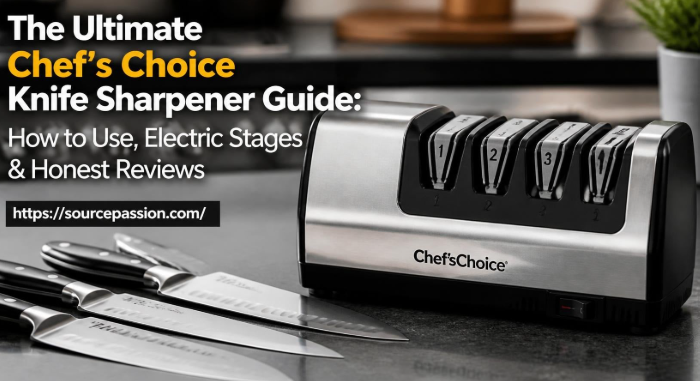
Chef’sChoice has become one of the best-known names in electric and manual knife sharpening. Its range includes sharpeners designed for traditional 20-degree Western knives, finer 15-degree Asian-style edges, and machines that can handle both.
This guide explains how Chef’sChoice sharpeners work, what each electric sharpening stage does, how to use one correctly, which models are worth considering, and the important disadvantages you should understand before buying.
Quick answer: Chef’sChoice electric sharpeners are designed to make consistent knife sharpening easier by controlling the sharpening angle for you. Models such as the 15XV focus on creating a 15-degree edge, while the AngleSelect 1520 is designed for both 15- and 20-degree knife profiles. The 1520 uses two sharpening stages plus a finishing stage, while the 15XV uses three stages to create and polish its 15-degree Trizor edge. Chef’s Choice+1
Chef’sChoice Knife Sharpener at a Glance
| Feature | What it means |
|---|---|
| Brand | Chef’sChoice / EdgeCraft |
| Main technology | Diamond abrasives and guided sharpening |
| Common edge angles | 15° and 20° |
| Electric models | Typically 2- or 3-stage systems |
| Finishing stage | Honing, stropping and polishing depending on model |
| Knife compatibility | Many straight-edge and selected serrated knives |
| Main advantage | Consistent angle with relatively little technique |
| Main drawback | Motorized sharpening can remove more steel than gentle manual maintenance |
| Best suited to | Home cooks who want speed and repeatability |
| Alternative | Whetstone sharpening for maximum control |
What Is a Chef’sChoice Knife Sharpener?
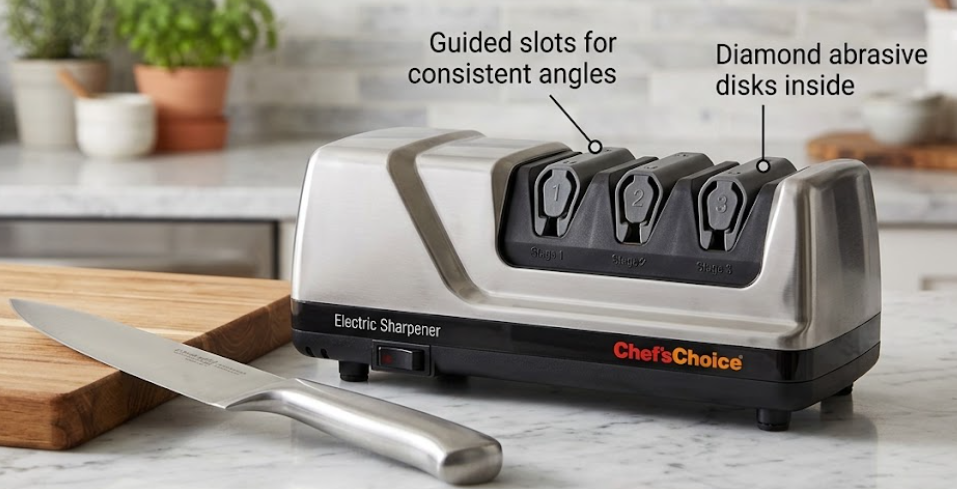
Chef’sChoice is a knife-sharpening brand from EdgeCraft that produces electric, hybrid and manual sharpening systems.
The basic principle is straightforward: an abrasive material removes or reshapes a small amount of metal at the knife edge. Finer abrasives then refine and polish that edge.
Chef’sChoice electric models combine this process with fixed or guided sharpening angles. That is important because maintaining a consistent angle by hand is one of the hardest parts of traditional knife sharpening.
The company’s current 1520 AngleSelect, for example, is designed for both 15-degree and 20-degree knives. Its first stage is intended for 15-degree knives, its second stage for 20-degree knives, and its third stage finishes either type. Chef’s Choice
The Chef’sChoice 15XV takes a different approach. It is designed around a 15-degree edge and uses three stages, with diamond abrasives in the first two stages and a finishing stage for polishing and serrated-knife work. Chef’s Choice
Understanding 15-Degree vs. 20-Degree Knife Edges
Before using an electric knife sharpener, you need to understand one crucial concept: edge angle.
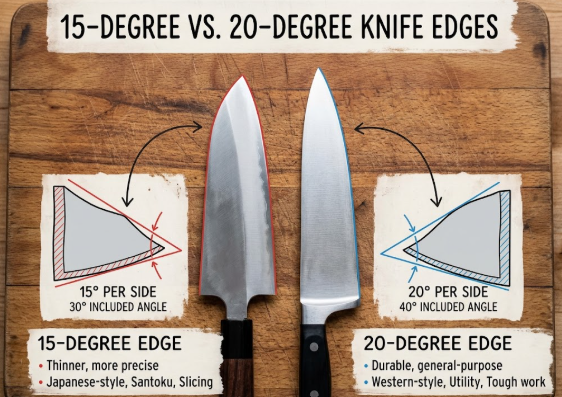
A knife’s advertised angle normally refers to the angle on each side of the blade.
So:
- A 15-degree-per-side knife has approximately a 30-degree included edge angle.
- A 20-degree-per-side knife has approximately a 40-degree included edge angle.
15-degree knife edges
A 15-degree edge is generally associated with thinner, more precise cutting performance.
It can be particularly useful for:
- Japanese-style kitchen knives
- Santoku knives
- Slicing knives
- Precision vegetable preparation
- Fine cutting tasks
The trade-off is that a thinner edge has less supporting metal behind the cutting edge.
Chef’sChoice itself notes that a conventional 15-degree edge can have less metal supporting the edge than a 20-degree edge. Its multi-bevel systems attempt to address this by creating a more supported, arch-shaped geometry. Chef’s Choice
20-degree knife edges
A 20-degree edge is traditionally associated with many Western-style kitchen knives.
It can be a practical choice for:
- General-purpose chef’s knives
- Utility knives
- Heavier kitchen work
- Knives that encounter tougher ingredients
- Older Western-style blades originally ground around 20 degrees
The key lesson is simple: sharper does not always mean thinner. The ideal edge depends on the knife, steel, geometry and intended use.
Chef’sChoice Electric Knife Sharpener Stages Explained
One of the most common questions is: What does each stage actually do?
The answer varies by model, but the general progression is:
Shape → Sharpen/Hone → Polish
Think of the stages as progressively finer steps rather than three identical sharpening slots.
Stage 1: Coarse Sharpening
The first stage generally performs the most aggressive work.
Its purpose can include:
- Rebuilding a badly worn edge
- Establishing the correct bevel
- Removing enough material to create a new cutting edge
- Converting an existing edge to a different angle on compatible models
On the Chef’sChoice 15XV, Stage 1 is described as a coarse grinding stage used to reshape the blade. The manufacturer’s review guidance says first-time sharpening can require considerably more work here than subsequent maintenance. Chef’s Choice
Important warning
Do not automatically run a perfectly sharp knife through the coarse stage every time.
Coarse abrasives remove more metal. Repeated unnecessary grinding can shorten the useful life of a blade.
For routine maintenance, use the least aggressive stage that restores the edge according to your model’s instructions.
Stage 2: Sharpening and Refinement
The second stage further refines the edge established during the first stage.
On the 15XV, Stage 2 continues sharpening and refining the 15-degree edge. On the 1520, Stage 2 is associated with traditional 20-degree knives. Chef’s Choice+1
This distinction is important because you should not assume that Stage 1 and Stage 2 have identical purposes across every Chef’sChoice model.
Always follow the instructions for your specific model.
Stage 3: Honing, Stropping and Polishing
The finishing stage uses a finer abrasive or stropping system to refine the cutting edge.
The purpose is not primarily to remove large amounts of metal.
Instead, it helps:
- Polish the edge
- Refine the newly sharpened bevel
- Improve cutting feel
- Maintain certain edges
- Handle serrated knives on compatible models
The 1520 uses patented stropping disks in its third stage, while the 15XV’s finishing stage is also designed for polishing and compatible serrated blades. Chef’s Choice+1
How to Use a Chef’sChoice Electric Knife Sharpener
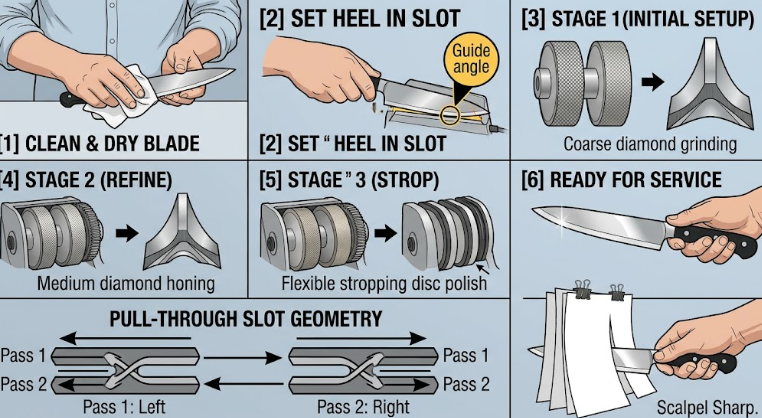
The exact procedure varies by model, but the following method explains the basic workflow.
Step 1: Clean the Knife
Start with a clean, dry knife.
Food residue or grease can interfere with smooth sharpening and leave debris inside the machine.
Chef’sChoice specifically recommends cleaning the knife before sharpening on several of its models. Chef’s Choice
Step 2: Place the Sharpener on a Stable Surface
Put the sharpener on a flat counter.
Keep your fingers away from the blade’s cutting edge.
The machine’s guides are designed to control the sharpening angle, so you generally do not need to force the knife sideways.
Step 3: Identify Your Knife’s Intended Edge
This is where models such as the 1520 have a major advantage.
If you have a 15-degree Asian-style knife, the appropriate sharpening stage is different from that used for a traditional 20-degree Western knife.
The 1520 specifically provides separate sharpening paths for 15- and 20-degree knives. Chef’s Choice
Step 4: Draw the Knife Through the Slot
Allow the machine to guide the blade.
Use a smooth, controlled motion from the heel toward the tip.
Do not stop in the middle of the blade.
Do not press excessively.
The goal is to allow the abrasive and guide system to do the work.
Step 5: Repeat on the Other Side
A conventional double-bevel knife needs both sides sharpened.
Follow the number of passes specified in your model’s instructions rather than assuming that more passes are better.
Step 6: Move to the Finishing Stage
Once the primary edge has been established, use the finishing stage according to the manufacturer’s instructions.
This is where the edge receives its final refinement and polish.
Step 7: Test the Knife Carefully
Instead of testing sharpness with your finger, use a safer cutting test.
Try slicing:
- A tomato
- A sheet of paper
- A soft fruit
- A piece of food you normally prepare
A properly sharpened knife should cut rather than crush or require excessive force.
Chef’sChoice 1520 vs. 15XV
Two of the most relevant Chef’sChoice electric models are the AngleSelect 1520 and 15XV.
They solve slightly different problems.
| Feature | Chef’sChoice 1520 | Chef’sChoice 15XV |
|---|---|---|
| Main concept | 15° + 20° flexibility | 15° Trizor edge |
| Stages | 3 | 3 |
| 15° sharpening | Yes | Yes |
| 20° sharpening | Yes | Designed to convert 20° knives to 15° |
| Finishing stage | Yes | Yes |
| Serrated compatibility | Yes, on compatible knives | Yes |
| Best feature | Angle flexibility | Consistent 15° conversion |
| Ideal buyer | Mixed knife collection | User wanting 15° edges |
The 1520 is particularly attractive if your knife collection contains both Japanese-style and Western-style blades.
Chef’sChoice describes it as being designed for both 15- and 20-degree classes, with precision guides intended to maintain the correct angle along the blade. Chef’s Choice+1
The 15XV is more specialized. It is built around the Trizor XV 15-degree concept and can convert compatible 20-degree knives to a 15-degree edge. Chef’s Choice+1
Honest Chef’sChoice Knife Sharpener Review
Marketing material tells you what a product is designed to do.
A useful review also asks what happens when real people use it.
That is where the picture becomes more nuanced.
What users like
Independent testing and customer feedback consistently highlight several benefits.
1. It is easy to learn
One of the biggest advantages over whetstone sharpening is that you don’t need to develop the same level of freehand angle control.
A former chef who evaluated multiple knife sharpeners for Consumer Reports’ Outside the Labs program described the 15XV as his favorite among the sharpeners he assessed, emphasizing its ease of use and consistent angle control. Chef’s Choice
2. It is fast
For someone who owns several kitchen knives, speed matters.
The 15XV review describes a complete first-time sharpening process as taking roughly a minute under appropriate conditions, with much quicker maintenance sharpening afterward. Chef’s Choice
3. It can produce very sharp edges
Food & Wine reported that a long-term user had used the Chef’sChoice 1520 for more than 13 years and described it positively for performance and durability. The publication also reported that the model performed strongly in a test involving 42 electric sharpeners. Food & Wine
4. It accommodates different knife types
The 1520’s ability to work with both 15-degree and 20-degree classes is particularly useful for households that own a mixture of knife styles. Chef’s Choice
The Downsides You Should Know
No sharpening system is perfect.
1. Electric sharpening removes metal
This is the most important trade-off.
A sharpening machine restores an edge by removing material. A coarse motorized abrasive can remove significantly more material than gentle routine honing.
That does not make the machine inherently bad. It means you should use the aggressive stages deliberately.
If your knife is already sharp, repeatedly performing a complete coarse sharpening cycle is unnecessary.
2. You can damage a knife through incorrect technique
The angle guides reduce the learning curve, but they do not make every possible mistake impossible.
Customer reviews include complaints about scratches, inconsistent results and damaged knives. Such reviews are useful warning signs, but they should not be interpreted as a measured failure rate because customer reviews are not a random sample of all products sold.
For example, Lowe’s customer reviews for the 15XV include many positive reports about speed and sharpness alongside individual complaints about units failing or other problems. Lowe’s
3. It costs more than a basic manual sharpener
Chef’sChoice electric models are substantially more expensive than simple pull-through sharpeners.
The manufacturer’s current listed price for the 1520 is $199.99, although retailer pricing can vary. Chef’s Choice
You are paying for:
- Motorized operation
- Angle guides
- Multiple sharpening stages
- Diamond abrasives
- Speed
- Convenience
For someone who sharpens one inexpensive knife twice a year, that investment may not make economic sense.
4. It is not the right tool for every knife
Be careful with:
- Single-bevel Japanese knives
- Extremely thin specialty blades
- Handmade knives with unusual geometry
- Ceramic knives unless the particular model explicitly supports them
- Knives with unusual edge constructions
Compatibility should always be checked against the exact sharpener model and the knife manufacturer’s recommendations.
Chef’sChoice vs. Whetstone: Which Method Is Better?
The answer depends on what you value.
| Category | Chef’sChoice Electric | Whetstone |
|---|---|---|
| Learning curve | Low to moderate | Moderate to high |
| Speed | Excellent | Slower |
| Angle consistency | High with guided models | Depends on skill |
| Control | Moderate | Excellent |
| Metal removal | Can be relatively aggressive | Can be very controlled |
| Portability | Moderate | Excellent |
| Skill development | Limited | Significant |
| Convenience | Excellent | Moderate |
| Professional-style customization | Limited | Excellent |
A skilled whetstone user can control bevel angle, pressure, abrasive progression and material removal very precisely.
But that expertise takes time.
For the average home cook who wants a sharp knife without spending weeks practicing sharpening technique, an electric guided system can be a practical compromise.
Chef’sChoice Knife Sharpener Pros and Cons
Pros
- Very easy compared with freehand sharpening
- Consistent sharpening angles
- Fast results
- Multiple sharpening stages
- Diamond abrasives on relevant models
- Some models accommodate both 15° and 20° knives
- Compatible models can sharpen serrated blades
- Useful for maintaining a household knife collection
Cons
- Higher purchase price than basic sharpeners
- Motorized abrasives can remove substantial metal
- Incorrect use can produce poor results
- Not every knife is suitable
- Coarse sharpening should not be overused
- Some users report mechanical or cosmetic problems
- A whetstone offers greater control for experienced sharpeners
How Often Should You Use a Chef’sChoice Sharpener?
There is no universal calendar schedule.
Knife sharpness depends on:
- How often you cook
- What foods you cut
- Your cutting board
- Knife steel
- Knife geometry
- Storage method
- Cutting technique
A better approach is to sharpen based on performance.
If a knife that normally cuts cleanly starts crushing tomatoes, slipping on onions or requiring noticeably more pressure, it may be time for maintenance.
A practical maintenance strategy
Sharp knife: Use normal maintenance.
Slightly dull knife: Use the appropriate finishing/honing stage if your model’s instructions allow it.
Clearly dull knife: Follow the sharpening procedure for the appropriate stage.
Seriously damaged or chipped knife: Consider professional sharpening or repair rather than repeatedly grinding away at it.
How to Get Better Results From an Electric Knife Sharpener
Keep the blade moving
Do not pause halfway through a sharpening slot unless the instructions specifically tell you to.
Use controlled pressure
More force does not automatically mean a sharper knife.
Let the abrasive work.
Don’t over-sharpen
Once the edge is restored, stop.
Extra passes only remove more material.
Learn your knife collection
Create a simple list:
| Knife | Original style | Typical angle | Sharpening approach |
|---|---|---|---|
| Japanese chef’s knife | Asian | ~15° | 15° system |
| Western chef’s knife | European/American | ~20° | 20° system |
| Santoku | Often Asian | ~15° | 15° system |
| Bread knife | Serrated | Model-specific | Compatible finishing stage |
| Single-bevel sushi knife | Japanese specialty | Model-specific | Do not assume standard settings |
The exact angle should come from the knife manufacturer whenever possible.
A Simple Knife-Sharpening Infographic
The Three-Stage Sharpening Process
DULL KNIFE
↓
Stage 1 — COARSE
Reshapes or establishes the bevel
↓
Stage 2 — REFINE
Sharpens and refines the cutting edge
↓
Stage 3 — POLISH
Hones/strops the edge
↓
SHARP KNIFE
↓
ROUTINE MAINTENANCE
The critical point is that these stages are not interchangeable. The exact function of each stage depends on the Chef’sChoice model.
Is Chef’sChoice Worth the Money?
For a household with several quality kitchen knives, the answer can make practical sense.
The value proposition is strongest when you prioritize:
- Convenience
- Speed
- Repeatable angles
- Minimal sharpening practice
- Maintaining multiple knives at home
It is less compelling if you:
- Enjoy whetstone sharpening
- Own inexpensive knives
- Sharpen only once or twice a year
- Need highly customized bevels
- Own unusual Japanese or specialty knives
The 1520 is particularly interesting for mixed knife collections because it supports both 15- and 20-degree sharpening profiles. Chef’s Choice
The 15XV makes more sense for someone specifically interested in the 15-degree Trizor-style edge. Independent reviews have praised its speed and consistency while also noting the trade-off of more aggressive material removal. Chef’s Choice+1
Chef’sChoice Knife Sharpener Buying Guide
Before purchasing, ask these five questions.
1. What angle are my knives?
If your collection is mostly 20-degree Western knives, you may not need a 15-degree conversion system.
2. Do I own Japanese knives?
If yes, angle flexibility becomes much more important.
3. Do I have serrated knives?
Check whether your chosen model explicitly supports them.
4. Do I care about preserving steel?
If you own expensive knives, learn how much material the sharpener removes and avoid unnecessary coarse-stage sharpening.
5. Do I want convenience or control?
Choose an electric sharpener for convenience and repeatability.
Choose a whetstone if maximum control and sharpening skill are priorities.
You can order from AMAZON
Key Takeaways
1. What angle are my knives?
- Chef’sChoice electric sharpeners use guided abrasive stages to make knife sharpening faster and more consistent.
- 15-degree edges favor precision and are common on many Asian-style knives.
- 20-degree edges are traditionally associated with many Western-style kitchen knives.
- The Chef’sChoice 1520 is designed for both 15° and 20° knife classes. Chef’s Choice
- The 15XV focuses on creating a 15-degree Trizor XV edge and can convert compatible 20-degree edges. Chef’s Choice+1
- Stage 1 is generally the most aggressive sharpening stage.
- The finishing stage is intended to refine and polish rather than aggressively reshape the blade.
- Don’t use coarse sharpening stages unnecessarily.
- Electric sharpeners prioritize convenience; whetstones provide greater control.
- Customer reviews are useful for identifying recurring experiences, but they should not be treated as controlled failure-rate data.
- Always check the instructions for your exact model before sharpening specialty knives.
Frequently Asked Questions
1. Is Chef’sChoice a good knife sharpener?
Chef’sChoice electric sharpeners are designed to provide guided, repeatable sharpening with relatively little freehand technique. Independent testing and long-term user reports have highlighted their speed, ease of use and ability to produce very sharp edges. Chef’s Choice+1
Whether one is appropriate depends on your knives and whether convenience is more important to you than maximum control.
2. What is the difference between a 15-degree and 20-degree knife edge?
A 15-degree-per-side edge is thinner and generally suited to precision cutting, while a 20-degree-per-side edge provides more metal behind the cutting edge and is traditionally associated with many Western knives.
Neither angle is universally better. The correct choice depends on the knife’s construction and intended use.
3. How many stages does a Chef’sChoice electric sharpener have?
It depends on the model.
The Chef’sChoice 1520 and 15XV both use three-stage systems, but their stage configurations differ. The 1520 accommodates both 15- and 20-degree classes, while the 15XV focuses on a 15-degree edge. Chef’s Choice+1
4. Can Chef’sChoice sharpen serrated knives?
Some Chef’sChoice models are designed to sharpen serrated knives, particularly through their finishing stages. However, compatibility varies by model, so check the manufacturer’s knife guide before using a particular serrated blade. Chef’s Choice+1
5. Can I use a Chef’sChoice sharpener on Japanese knives?
Some models are specifically designed for 15-degree Asian-style knives. The 1520, for example, includes a 15-degree sharpening path. Chef’s Choice
However, extremely thin, single-bevel or specialty Japanese knives require additional caution.
6. Does an electric sharpener remove too much metal?
It can remove more material than gentle manual maintenance, particularly when using a coarse sharpening stage.
That is why the coarse stage should be used only when necessary and according to the instructions for your particular model.
7. Is a Chef’sChoice sharpener better than a whetstone?
They serve different users.
Chef’sChoice is primarily about convenience, speed and repeatable angles. A whetstone offers greater control but requires more skill and practice.
For a busy home cook, an electric guided sharpener can be much easier to use consistently. For an experienced sharpener, a whetstone may provide greater flexibility.
Final Verdict: Who Should Buy a Chef’sChoice Knife Sharpener?
Chef’sChoice electric sharpeners occupy an interesting middle ground between simple pull-through sharpeners and traditional freehand sharpening.
They are not magic machines, and they are not appropriate for every knife. Their biggest advantage is consistency. The guided system removes much of the difficulty involved in holding a knife at a precise angle, while multiple abrasive stages allow the edge to be reshaped, refined and polished.
The Chef’sChoice 1520 is especially relevant for cooks who own a mixture of 15- and 20-degree knives. Its AngleSelect design lets users work with both categories rather than forcing an entire knife collection into one geometry. Chef’s Choice
The 15XV is more specialized. It is built around a 15-degree Trizor XV edge and is particularly attractive to users who want a fast way to convert compatible knives from a conventional 20-degree edge to a finer 15-degree profile. Chef’s Choice+1
The biggest mistake is treating an electric sharpener like a toy and repeatedly grinding knives simply because the machine makes sharpening easy. Used thoughtfully, the technology can be an effective home-kitchen maintenance system. Used aggressively, it can remove unnecessary steel.
For most buyers, the smartest approach is therefore simple: identify your knife’s edge geometry first, choose a compatible Chef’sChoice model, follow its stage instructions, and sharpen only when the knife actually needs it. You can order this from AMAZON